Saturday, October 4, 2014

More Apples and More Apples!

There are apples in the box.  As there were last week, and as there will be for the next several weeks.  And it's a good thing.  Apples are a major crop for Virginia.


Okay,  but how many times in a row can one eat baked apples, or cobbler?  You start seeing the same syndrome as we had with zucchini in the summer.

So let's see what we can do to move apples from dessert to the main meal.  Here we go, savory dishes with apples!

Pork
Apples and pork is an incredibly classic combination that has stood the test of time.  Whether the apples are roasted, pan-seared, braised in a stew, or sautéed, the apples lend a sweetness that brings out the flavor of the pork.

Stuffing
Have you started thinking about Thanksgiving menus yet?  Stuffing has to be one of my favorite items on the holiday table.  Okay, all of the dishes are one of my favorites, who are we kidding?  The heavily-herbed, sage-loaded dish of yesteryear isn't the only option!  Apples and chestnuts in stuffing lighten and sweeten it.  This recipe is the stuffing I make almost every year.  This one includes bacon, whose saltiness balances out the sweet from the apples.  This recipe for acorn squash uses another apple and chestnut stuffing, but the rye bread lends a lot of character to it.  If you can find a sourdough rye, that's even better!

Other meats
Pork isn't the only meat to compliment apples.  This is a fantastic way to make Cornish hens.  Every Easter, I make ham in an apple-Riesling sauce.  Okay, yes, ham is pork.  Preparing it seems different enough in my book to warrant its own category.  Author's prerogative!

Photo via A Touch of Zest
Vegetarian Options
When I was growing up, potato pancakes were made from leftover mashed potatoes.  When I started making them from shredded potatoes, it went up to another level.  But latkes with sweet potatoes?  And apples?  Whoa!  Awesome!  I also recently stumbled across these multi-grain pancakes with shredded apple, which are amazing.

But let me share a family secret.  Braised red cabbage, or Rotkohl, is a staple of northern European cuisine.  It's one of those dishes that is fairly easy to prepare, but improves over decades of practice.  And here's our family recipe:

Rotkohl
Ingredients
  • 1 small head red cabbage
  • 2-3 tart apples, peeled, cored & diced small
  • 1/2 cup cider vinegar, plus more to taste
  • 1/2 cup full-bodied red wine
  • 1/4 cup sugar or honey, plus more to taste
  • 4 allspice berries
  • 6 juniper berries
  • 4 black peppercorns
  • 2 whole cloves
  • Small spice bag, tea egg, or snippet cheesecloth
  • Salt to taste
Directions
  1. Put spices in tea egg or spice bag, or into a cheesecloth satchel.  Place in bottom of slow cooker.
  2. Loosen shredded cabbage and place in slow cooker.  Toss in apples and sugar or honey.  Add liquid ingredients and salt generously.
  3. Cook on low 8 hours or longer.  About 20 minutes before serving, taste and add vinegar, sweetener, or salt to taste.  Stir well and cook 20 minutes longer.  Strain before serving.

Thursday, October 2, 2014

Staples of Fall


There were lots and lots of turnips in the box this week.  Fall is the season for root veggies:  turnips, potatoes, carrots, rutabagas, onions, lots of goodness.  These are the components of good, hearty fall meals.

Lots of people wonder what to do with turnips.  Honestly, use them in anything where you'd use potatoes or carrots.  Turnips are related to horseradish, and they'll add some of that sharp, in-the-nose quality, albeit in much milder form.  Turnips contain a fair amount of sugar, too, which you can caramelize.  Let's make a simple stew.

Photo via Epicurious
Veggie Stew
Pick whichever root veggies you'd like.  Some of those turnips, for example.  Peel and cut into bite-sized chunks.  Add some aromatics too, like onions, celery, and/or fennel.  Again, chop into bite size pieces.  It doesn't matter how much of what ingredient.  Use more of the ones you like more.

Here's my Stew Secret.  Put a pan (or a wok, if you have one) over high heat, and let the pan pre-heat for a minute or two.  Put in some high smoke point oil, such as grape seed or peanut, and let it warm up for a few seconds. Toss the veggies in and stir continuously just until they've got some brown on them, but not black.  The brown is caramelized sugars.  Good stuff. Turn the heat to low, sprinkle on some flour (a tablespoon or two), then stir well for maybe a minute.  Put the veggies into a pot or slow cooker.  

Add some flavorful liquid. This could be wine, stock, or a robust beer.  My favorite stews use a good Belgian beer.  (Even if you don't like to drink them, those beers take on a different character in a stew.) Optionally, you can put in some herbs (bay, thyme, etc.).  Let it cook low and slooooooow all day.  Salt & pepper only after its done.  Now, how easy was that?

Photo via Food & Wine
Variations on a Theme
That's a vegetable stew, and it's heartier than you think.  Of course you can add meat of any kind, especially the cheaper cuts, which benefits from lots of low heat cooking.  Just like the veggies, cut into bite-size pieces, brown, add a little flour, and in the pot.

Here are some good recipes I've used, but you'll see that they're all variations on this theme.  Many stew recipes will only list carrots, but adding in other root vegetables can't be a bad thing!  Tomato paste enriches and sets apart this classic Bistro stew.  And, speaking of flavorful liquids, how about some cognac in your beef stew?  Fall is football season, and stews are great for watching the game.  Our family's absolute favorite stew, though, has to be this southwest-inspired one.  Here's another southwestern stew, this time a bit spicier.

Happy fall!

Friday, September 26, 2014

As the Weather Cools

The pumpkin tunnel is open this weekend!  Make sure to stop by and pick up some pumpkins!
Okay, now it's seriously fall.  Everything is orange now, especially lots and lots of pumpkins.  Jack-o-lanterns?  Well, not quite yet.  But it is time for [drumroll]... pumpkin soup!!  Wahoo!  First things first.  Do not use canned pumpkin.  You will absolutely notice the difference, and it's well worth the effort.  Here's what you do:  Cut the pumpkins in half, regardless of size.  (Be careful, often you have to put some force behind your knife to cut pumpkin or acorn squash.  Use a sharp knife, in other words get yours sharpened, and be extra mindful of where your hands and fingers are.)  Take out the seeds and strings, drizzle with olive oil, and salt and pepper.  Wrap tightly in foil, and bake at 350˚F for about 90 minutes.  Ta da!  It's soft, let it cool and scrape the pulp off the skin.  I put it in 8oz paper cups and freeze it, then take the cup off and leave in a Ziploc in the freezer.  On a cool spring day, it's nice to make pumpkin pie again.

Butternut, and pretty much any other orange flesh squash make really good soup!
As for the soup itself, it's a very blank canvas upon which you can try lots of things.  Boil the pumpkin in chicken, vegetable, or even seafood stock (especially lobster!), add aromatics (celery, onion, carrots, fennel, that sort of thing), herbs and spices, and cook.  Use an immersion blender to purée the soup, and reduce until it's the desired consistency.  Finishing with a little butter or cream makes it even awesomer.

As for what seasonings to use, it's pretty wide open.  Everything from the creole recipe linked above, to curry, to something fancy with saffron will work.  (By the way, if anyone gets the pumpkin bowl thing in that last recipe to work, email me and tell me how you did it.)  This recipe is a hearty version with ham.  Or, for simplicity, I just use the same spices that go in pumpkin pie with just a small handful of brown sugar and some sage.  That one's pretty classic.

It's fall.  Enjoy it while it's here!  I hope to see you and the kids at the pumpkin tunnel this weekend.  Happy soup cooking!

So how much soup would one of the big boys make?


Thursday, September 18, 2014

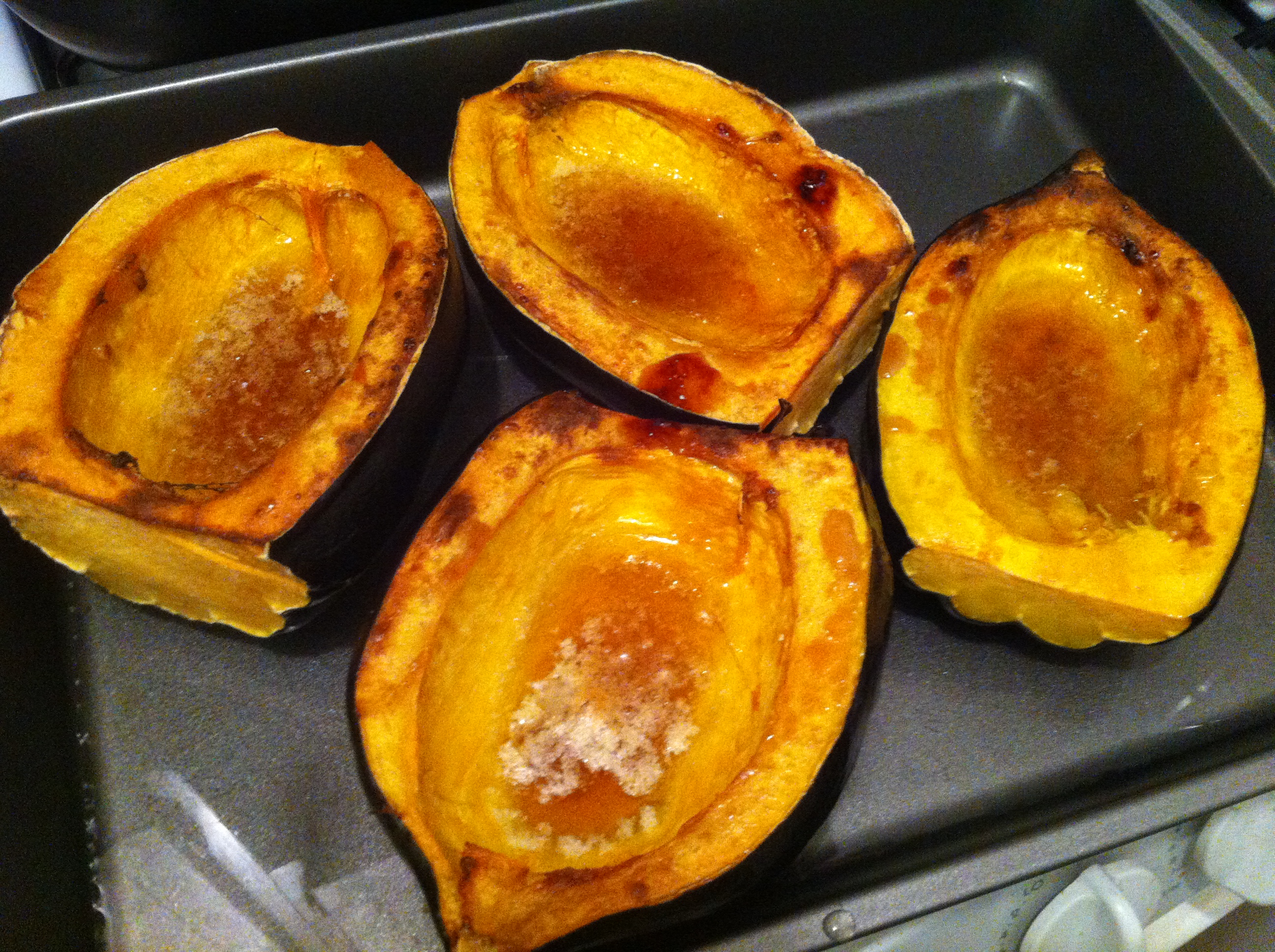
Acorn squash

Finally!  This week starts winter squash.  Acorn squash, to be specific.  Wahoo!


Yeah, I guess I get excited about these things a little too easily.  But this makes it okay to start fall now.  Great!  So what do we do with it?

Acorn squash is quite the blank canvas.  In most cases it's baked.  Like most winter squash, you'll need to plan some time for this.  Definitely worth the wait!  The recipes we're going to look at today involve cutting it in half, scooping out the seeds, and roasting it.  Usually, this is done in two phases,  First, salt and pepper the inside of the squash, coat with some olive oil, and put it in a roasting pan.  Adding 1/2" water to the pan keeps the squash from scorching and sticking.  Bake at 350-400˚ for about 30 minutes.  Add the filling, and bake it for about another 30 minutes.

It's what gets put back in the center that makes the difference.  Stuffings can be either sweet or savory.  For example, for the savory option, stuffing it with meat and herbs.  Interestingly, acorn squash lends itself to spiced stuffings as well, such as this Moroccan recipe or even this one with hot peppers.

Photo via Food & Wine


A savory-sweet stuffing works well, but you can even make acorn squash into dessert.  Below is a slightly modified recipe I got from a cookbook I found at Mohegan Sun casino's gift shop.  Cranberry-stuffed acorn squash can almost be a dessert!  (For fall recipes, Native American-inspired cooking is full of interesting ideas.  One of my most prized cookbooks is one by the chef at the National Museum of the American Indian.  If you haven't eaten in the cafeteria there, GO NOW.  I'd put it up against any high-end restaurant I've experienced.)

Cranberry-stuffed Acorn Squash
Ingredients:
  • 4 acorn squash
  • 1 1/2 cups whole fresh cranberries
  • 1/2 tsp grated orange zest
  • 1/2 cup apple sauce
  • 1/2 cup maple or brown sugar 
  • 1 tbsp hazelnut oil (do not substitute for this!)
Directions:
  1. Cut each squash into halves and discard the seeds.  Trim the ends so that the halves will stand.  Place cut side down in a baking dish and bake at 350 degrees for 35 minutes.  Cool to room temperature.
  2. Combine the cranberries, orange zest, apple sauce, sugar, and hazelnut oil in a bowl and mix well.  Spoon into the squash.  Place filled side up on a baking sheet and bake for 30 minutes longer.  Serve immediately, with whipped cream if desired.