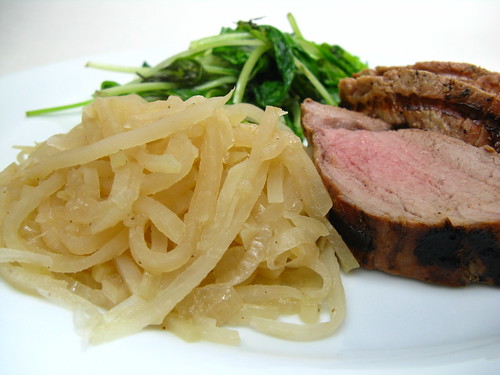
What the heck is kohlrabi?
More importantly, what do I do with
it?
First off, let me introduce
myself. I’m Burt, and I’ll be writing
most of the posts on this blog. This is
my first foray into food blogging, but it’s something I’ve wanted to do for
some time. I’m really looking forward to
sharing my culinary experiences with you, and learning of yours as well. Ideas, recipes, questions, comments and rude
remarks are all welcome
at burt@nallsproduce.com. Well, not just yet, though. Waiting for the technology fairies to set it up. Bonus points for the first one to tell me who
the quote “Questions, comments, rude remarks?” comes from.
Kohlrabi is a vegetable common
in northern Europe. The name even comes
to us from German. It’s an amalgamation
of the words for “cabbage” and “turnip.”
That sort of explains the taste as well:
a mild cross between turnip and cabbage.
(Quite logical, those Germans, aren’t they?) You can eat it raw, or boil it until tender
and then do lots of different things with it.
I’m from the northern Midwest, and
there are lots of German influences in that part of the country. Growing up, my mom would make kohlrabi
frequently when it was in season. When
we had it, the preparation was quite simple:
boil them until tender, then make a simple cream sauce and bake for a
couple of minutes. mmm… I can still
remember having that. As a matter of
fact, I think that’s what I’m going to do with the ones in my box this week.
Here’s what you do. While the entire plant is edible, I just use
the root bulbs. Take off the stalks, and
either save for stock or compost. Peel
the bulbs until you just see the white flesh.
Slice into disks about ¼ inch thick, cutting in half if they’re
large. Boil the kohlrabi until you can
pierce them with a fork, drain, and set aside.
To make the cream sauce, over medium heat melt some butter or margarine
(maybe 2 tablespoons, more if you’re feeding an army). Add an equal amount of flour, and
continuously stir. This is called a roux, and you can use it to thicken
sauces and soups. You can use flour and
an equal amount of any liquid fat: oil,
butter, bacon grease, duck fat… okay, let’s not get too crazy.
The longer you cook the roux, the
darker it’ll get. The darker it gets,
the stronger (more smoky) the flavor becomes.
When your roux is ready, add maybe a cup of warm milk, whisking to make
sure it doesn’t get lumpy. Let it
thicken just a little, then add the kohlrabi and some salt and pepper. If your sauce doesn’t cover all of the
veggies, then add a touch more milk and let it thicken again. Bake it in a 350-ish oven for maybe 10
minutes, and enjoy!
I’ve heard you can make a simple au
gratin with it as well, but I’ve never tried it. If you do, let me know how it goes.
Kohlrabi can also be eaten raw,
usually by cutting it julienne and making a slaw. I’ve used
this
recipe, which includes apples and parsley.
Another thing on my list to try is to use it in the slaw for fish
tacos. I’ve found some likely candidates
for recipes
here,
here
and
here.
One
last parting word. It’s also Herb Season.
It’s not too late for you to plant some pots of herbs. If you don’t think you’d like to go through
the trouble, just take a stroll through a grocery store and see how much fresh
herbs go for. Buying one plant is about
the same cost as one package of cut herbs, which will last you maybe a
week. Plus, growing herbs is pretty
fool-proof. Trust me, I’ve tried to mess
it up. If I can grow herbs, you can
too. If you don’t have a lot of space,
you only need a couple of small pots to tuck on a windowsill here and
there. Fresh herbs are one of the best additions
you can make to your cooking. Stop by
and ask one of Your Friendly Neighborhood Nalls Employees, and they’ll have
plenty of advice to get you started.
If
you have more interesting recipes or tips for this week’s CSA contents, please
leave them in the comments. One of the
great things about Nalls is that it’s part of the community, of which you are
also a part. Join the discussion, and
we’ll all be fantastic home chefs. Happy
cooking!